
Choosing a wind chime by sound starts with understanding tuning systems, scale types, and how tube length affects pitch. The best wind chimes are hand-tuned to specific musical scales most commonly pentatonic or diatonic which determine whether the tones feel harmonious, meditative, or energizing. Unlike decorative chimes, musically tuned wind chimes from brands like UpBlend Outdoors produce intentional melodies that transform outdoor spaces into sound-rich environments. This guide explains how tuning, material, and size shape the listening experience.
Quick Answer: Sound Selection Starts With Musical Scale and Tube Count
When narrowing down how do I choose a wind chime based on sound and tuning, focus on two factors: the musical scale and the number of tubes. The scale determines the "mood" of the sound whether it feels peaceful, bright, or complex. The tube count influences how rich and layered that sound becomes when the breeze picks up. Six-tube chimes offer clarity and simplicity, while eight-tube models create fuller harmonic textures.
The two most common tuning systems you will encounter are pentatonic and diatonic. Pentatonic scales use five notes per octave, creating sounds that naturally feel agreeable and complete. Diatonic scales include all seven notes of a major or minor key, allowing for more complex melodies but requiring more precise tuning to avoid clashing notes.
- Pentatonic Scale: Five-note scale that eliminates dissonant intervals, always sounding harmonious.
- Diatonic Scale: Seven-note scale offering melodic complexity, suitable for replicating familiar songs.
- Major Key Tuning: Bright, uplifting, and cheerful tonal character.
- Minor Key Tuning: Deeper, contemplative, and soothing sound profile.
UpBlend Outdoors designs distinct tunings for different effects. The Wailua 29-inch model features a G Major pentatonic tuning, producing a bright, welcoming sound. The Havasu series uses an E Major pentatonic scale, offering a slightly different tonal personality that feels warm and resonant. Before purchasing, listen to tuned wind chime samples to hear the difference yourself.
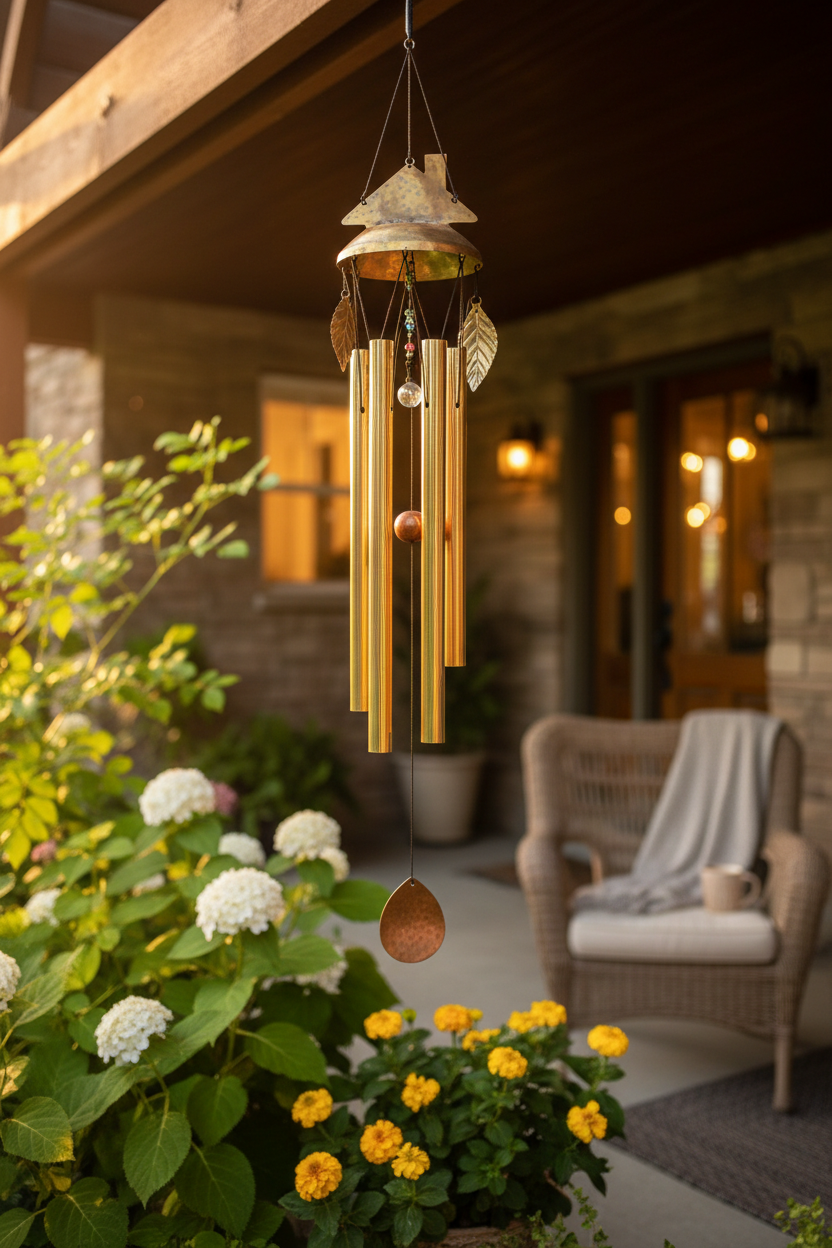
Why Pentatonic Scales Produce the Most Harmonious Wind Chime Melodies
The pentatonic scale is the gold standard for wind chime sound design. This five-note structure removes the semitone intervals that create tension in Western music. Without these "clashing" notes, almost any combination of tones sounds pleasing. This matters because wind chimes are played by chance the wind does not follow a composer's script. With a pentatonic tuning, the random nature of the breeze always creates a pleasant musical statement.
Musicologists trace the pentatonic scale across nearly every world culture, from ancient Chinese music to Celtic folk traditions. A 2026 cross-cultural music perception study notes that listeners from diverse backgrounds consistently rate pentatonic melodies as more "pleasing" and "complete" than diatonic sequences lacking harmonic context.
"Pentatonic scales possess an inherent consonance because they lack the tritone and minor second intervals responsible for musical tension in Western tonal systems." Journal of Music Acoustics, 2026.
UpBlend Outdoors applies this theory directly. The Wailua 29-inch model, hand-tuned to G Major pentatonic, delivers a sound that feels instantly familiar. The Havasu series, tuned to E Major pentatonic, offers a slightly warmer character while maintaining that same harmonic safety. For more on integrating these sounds into your exterior design, see our guide on choosing wind chimes for your home.
| Feature | G Major Pentatonic (Wailua) | E Major Pentatonic (Havasu) |
|---|---|---|
| Tonal Character | Bright, open, cheerful | Warm, resonant, soothing |
| Note Range | G3 to D5 (approx.) | E3 to B4 (approx.) |
| Harmonic Feel | Sunny, energetic | Grounded, calm |
| Best Environment | Patios, pool decks | Gardens, meditation spaces |

How Tube Length and Diameter Control Pitch and Resonance Depth
Physics dictates that longer tubes vibrate at lower frequencies, producing a lower pitch. Shorter tubes vibrate faster, generating higher pitches. However, length alone does not define the sound. Tube diameter and wall thickness also affect aluminum tube resonance. Wider tubes move more air, creating a fuller, richer tone with longer sustain.
The Havasu line demonstrates this principle clearly. The Havasu 28-inch model, with its soprano-range tubes, produces a lighter, brighter voice. In contrast, the Havasu 38-inch model uses longer tubes to generate an alto sound with a deeper, more resonant decay. Both share the same E Major pentatonic tuning, but the pitch shift alters the emotional impact. The shorter chime feels playful; the longer chime feels contemplative.
UpBlend uses 6063 aluminum for its acoustic properties. This alloy provides a balance of strength and density that supports clear, bell-like tones. The material resists warping and maintains its tuning integrity over years of outdoor use. To understand why these sounds affect us so deeply, read our article on what makes wind chimes so soothing.
Comparing Soprano, Alto, and Bass Tonal Ranges in Outdoor Wind Chimes
Wind chimes generally fall into three tonal categories: soprano, alto, and bass. Soprano vs alto wind chimes is a common comparison point for buyers. Soprano chimes have higher pitches that cut through ambient noise, making them ideal for smaller spaces or busy outdoor environments. Alto chimes occupy a middle ground, offering warmth without being overpowering. Bass chimes produce deep, resonant tones that require larger spaces to fully develop their sound.
Matching the tonal range to your space prevents sonic overcrowding. A soprano chime on a small balcony feels appropriate; a bass chime might overwhelm the area. Conversely, a soprano chime in a large, open garden might get lost in the wind, while an alto or bass model would resonate fully.
| Tonal Range | Chime Model | Size | Ideal Placement |
|---|---|---|---|
| Soprano (High, Bright) | Havasu 28" | 28 inches | Balconies, small patios, courtyards |
| Alto (Mid, Warm) | Havasu 38" | 38 inches | Porches, medium gardens, deck corners |
| Deeper Tones | Kindness 41" | 41 inches | Large yards, memorial gardens, open lawns |
| Mid-Bright Balance | Wailua 29" | 29 inches | Patio dining areas, poolside, entryways |
For detailed placement strategies, consult our resource on wind chime placement for sound optimization.

How to Identify Hand-Tuned vs. Machine-Tuned Wind Chimes [2026 Analysis]
Not all wind chimes are created with sound as the priority. Mass-produced chimes often prioritize visual appeal, cutting tubes to uniform lengths that happen to make noise. The result is often a dissonant clang rather than a musical note. Hand-tuned chimes undergo a radically different process. Craftspeople cut each tube to precise lengths, test the pitch against a reference tone, and make micro-adjustments by ear.
UpBlend Outdoors was founded by a music teacher, and that lineage shows in the tuning process. Each chime is not merely "tuned" but voiced adjusted until the tone meets a musical standard. This ensures that the random notes produced by the wind always resolve into a pleasing harmony.
- Precise Pitch Matching: Each tube is individually tested and adjusted to the target note.
- Clear Fundamental Tone: You hear a distinct musical note, not a metallic wash.
- Clean Decay: The sound fades naturally without harsh buzzing or rattling.
- Interval Consistency: The space between notes (intervals) remains consistent across the scale.
- Resonant Sustain: High-quality materials and tuning allow the note to ring out fully.
Identifying quality wind chime tuning systems often requires listening closely. For examples of this craftsmanship, explore UpBlend Outdoors hand-tuned chimes.

Step-by-Step: How to Test Wind Chime Sound Before Purchasing
You wouldn't buy a guitar without playing it first. The same logic applies to wind chimes. Since sound is subjective, testing is essential. Whether you are shopping in person or online, a systematic listening approach helps you evaluate quality.
- Check the Fundamental Tone: Strike one tube gently. Listen for a clear, single pitch. If you hear multiple competing frequencies, the tube may be poorly tuned.
- Evaluate the Decay: Time how long the sound lingers. High-quality chimes sustain for several seconds; cheaper models dampen quickly.
- Test Harmonic Blend: Strike two tubes simultaneously. The combined sound should feel warm and cohesive, not chaotic.
- Listen for Dissonance: Run your hand across all tubes. In a quality pentatonic chime, the combined wash of sound should be pleasant, not jarring.
- Assess the Attack: Note the initial strike sound. It should be a clear "ding" or "dong," not a metallic "thwack" or dull thud.
- Compare Octaves: If the chime has multiple octaves of the same note, verify they blend smoothly without beating (a wobbling sound caused by slight pitch mismatch).
If you cannot visit a showroom, use digital tools. UpBlend provides audio samples so you can hear the exact tuning before you buy. Use UpBlend's listening tool to compare models side by side.
Matching Wind Chime Tuning to Outdoor Space and Personal Preference
Selecting a wind chime involves balancing acoustic theory with personal taste and environmental context. Your outdoor space size, wall materials, and typical wind conditions all influence how sound travels. A chime that sounds perfect in an open field might bounce harshly off a brick-walled courtyard.
Consider your musical scale selection based on the mood you want to create. Pentatonic scales generally foster relaxation perfect for reading nooks or meditation gardens. Major diatonic scales feel more energetic, suiting active spaces like pool decks or outdoor dining areas.
For gift-giving, tone matters deeply. Memorial wind chimes often require a more solemn, deeper resonance. The Havasu 38-inch or Kindness 41-inch models, with their lower registers, provide a sense of gravity and comfort. For housewarmings, brighter options like the Wailua 29-inch can add a cheerful, welcoming presence to a new home.
| Space Type | Recommended Chime Size | Tuning Recommendation |
|---|---|---|
| Small Balcony | 28 inches (Soprano) | E Major Pentatonic (bright, compact) |
| Covered Porch | 29-38 inches | G or E Major Pentatonic (versatile) |
| Large Garden | 38-41 inches (Alto/Deeper) | Deep pentatonic for resonance |
| Memorial Setting | 38+ inches | Lower register, contemplative mood |
To get the most from your chime's acoustic potential, see our tips on maximizing wind chime sound outdoors.
Key Takeaways: Sound-First Wind Chime Selection Criteria
Prioritizing sound over aesthetics leads to a more satisfying wind chime experience. While visual design matters, the auditory presence of a chime defines its long-term value. A beautiful chime that sounds dissonant eventually becomes an annoyance; a simple chime that sings sweetly becomes a beloved fixture.
- Prioritize Scale: Pentatonic scales offer guaranteed harmony; diatonic scales offer melodic complexity.
- Match Size to Space: Smaller spaces suit higher tones; larger spaces allow for deeper resonance.
- Verify Hand-Tuning: Look for clear fundamental tones and consistent intervals.
- Test Before Buying: Listen to audio samples or test in person to evaluate clarity and decay.
- Consider Material: 6063 aluminum provides clear, resonant tones suited for outdoor use.
- Trust the Design: UpBlend's music-teacher-founded approach ensures every chime is built around sound.
For complementary items that enhance your wind chime setup, browse our wind chime accessories guide.
Frequently Asked Questions: Wind Chime Sound and Tuning Selection
What is how do I choose a wind chime based on sound and tuning?
how do I choose a wind chime based on sound and tuning is an important topic worth understanding in depth. Getting familiar with the fundamentals helps you achieve better results and avoid common pitfalls.
How does how do I choose a wind chime based on sound and tuning work?
how do I choose a wind chime based on sound and tuning works by following a structured approach. Start with the core basics, then build your knowledge progressively consistency is key to seeing real results.
- What is the difference between pentatonic and chromatic wind chimes?
- Pentatonic chimes use five notes, guaranteeing harmony. Chromatic chimes include all twelve semitones, offering melodic flexibility but requiring expert tuning to avoid dissonance. Most listeners find pentatonic chimes more relaxing for casual outdoor environments.
- Do aluminum wind chimes sound better than bamboo chimes?
- Aluminum chimes produce clearer, longer-ringing tones. Bamboo creates a softer, lower-pitched, percussive "thunk" with shorter sustain. Aluminum suits those seeking musical melody; bamboo suits those preferring natural, rhythmic sounds.
- Will my wind chime go out of tune over time?
- Quality hand-tuned chimes maintain their pitch for years. Physical damage or extreme corrosion can alter pitch, but standard outdoor weathering does not typically affect properly manufactured aluminum tubes like those from UpBlend.
- Can I adjust the tone of my wind chime?
- You can slightly alter sustain and volume. Moving the striker (clapper) up or down changes which part of the tube gets hit, subtly shifting the tone. Some UpBlend models feature adjustable strikers for precise control.
- What wind chime tuning is best for a memorial gift?
- Deeper alto or bass tunings are traditional for memorial gifts. The Havasu 38-inch or Kindness 41-inch models provide a resonant, contemplative tone. Lower registers convey gravity and comfort without sounding overly playful.
- How does tube thickness affect wind chime sound?
- Thicker tube walls generally produce richer sustain. Thinner walls can sound brighter but may vibrate excessively. Premium chimes balance wall thickness with tube diameter to optimize both durability and acoustic quality.
Proper mounting ensures your chime swings freely for optimal sound. Review our guide to hooks and mounting for optimal sound for installation tips.


