
A pentatonic wind chime is tuned to a five-note musical scale that eliminates dissonant intervals, creating a sound where every combination of notes harmonizes naturally. Unlike randomly pitched chimes, pentatonic designs such as those in G Major or E Major produce melodic, consonant tones that feel soothing and musical regardless of wind pattern. This tuning approach, rooted in traditions spanning cultures from East Asia to Celtic music, ensures your outdoor space sounds intentional rather than chaotic.
Quick Answer: Pentatonic Tuning Eliminates Dissonance in Wind Chimes
At its core, a pentatonic scale strips away the notes that traditionally cause harmonic tension. By using only five notes per octave instead of the standard seven, you remove the half-step intervals that create clashing or dissonant sounds. This leaves a framework where every note sounds pleasant when played alongside any other note in that set.
This five-note structure is exactly why pentatonic wind chimes work so well in unpredictable outdoor conditions. The wind does not follow a musical score it creates random patterns of movement. If you have a chime tuned to a chromatic scale, those random gusts might produce harsh or jarring combinations. With pentatonic tuning, the physics works in your favor.
UpBlend Outdoors applies this principle across their product lines. Their Wailua series uses a G Major pentatonic scale, while the Havasu series features an E Major pentatonic tuning. Both options ensure that whether a gentle breeze or a strong gust moves the tubes, the resulting sound remains pleasant and coherent.

For those who want to experience the difference firsthand, you can listen to pentatonic wind chime examples to hear how the tuning shapes the listening experience.
- Guaranteed Harmony: Any combination of the five notes sounds consonant and pleasant.
- Random-Friendly Design: Unpredictable wind patterns still produce musical results rather than noise.
- Universal Appeal: Pentatonic scales appear in musical traditions worldwide, making the sound immediately recognizable.
The Musical Architecture Behind Pentatonic Wind Chime Scales
To understand why five notes create such consistent harmony, you need to look at the intervals between those notes. In a standard Western diatonic scale the "do re mi" scale most of us learned in school there are seven notes per octave. Those seven notes include two half-step intervals (mi to fa and ti to do) that create tension and dissonance when played simultaneously.
A pentatonic scale removes those problematic half steps entirely. Take the G Major pentatonic scale used in the Wailua 29-inch wind chime: G-A-B-D-E. Notice that it skips the fourth and seventh scale degrees of the full G Major scale, precisely the notes that would create those tight, dissonant intervals. What remains is a set of notes that sound agreeable in any combination.
The physics of aluminum tubes plays a role here as well. When a tube is struck, it produces not just a primary tone but a series of overtones. Hand-tuned outdoor chimes account for these harmonic series, ensuring that even the secondary resonances align with the pentatonic structure.

This attention to interval relationships is part of what makes wind chimes soothing the math behind the music creates a naturally relaxing effect.
| Feature | Pentatonic Scale (5 Notes) | Diatonic Scale (7 Notes) |
|---|---|---|
| Note Count | Five notes per octave | Seven notes per octave |
| Half-Step Intervals | None removed by design | Two (mi-fa, ti-do) |
| Harmonic Guarantee | Any combination sounds consonant | Some combinations create tension |
| Wind Suitability | Excellent random patterns work | Poor needs controlled sequence |
| Common Example | G Major: G-A-B-D-E | G Major: G-A-B-C-D-E-F# |
How Pentatonic Wind Chimes Sound: Tonal Characteristics Analysis [2026 Data]
The listening experience of a well-made pentatonic wind chime is distinct from that of generic, randomly tuned chimes. The first thing you notice is the absence of clashing. Even when multiple tubes sound simultaneously which happens frequently in gusty conditions the tones layer together smoothly rather than fighting each other.
This consonance creates what musicians call a "resolved" sound. There is no musical tension demanding resolution, no sense that a wrong note needs to be corrected. The sound simply exists in a state of harmonic agreement.
Material choice significantly affects the character of that sound. UpBlend uses 6063 aluminum tubes, an alloy chosen for its acoustic properties. Aluminum produces a clear, bright tone with excellent sustain the note continues to ring after the initial strike. This sustained resonance allows the overlapping notes of a pentatonic scale to blend and decay together musically.
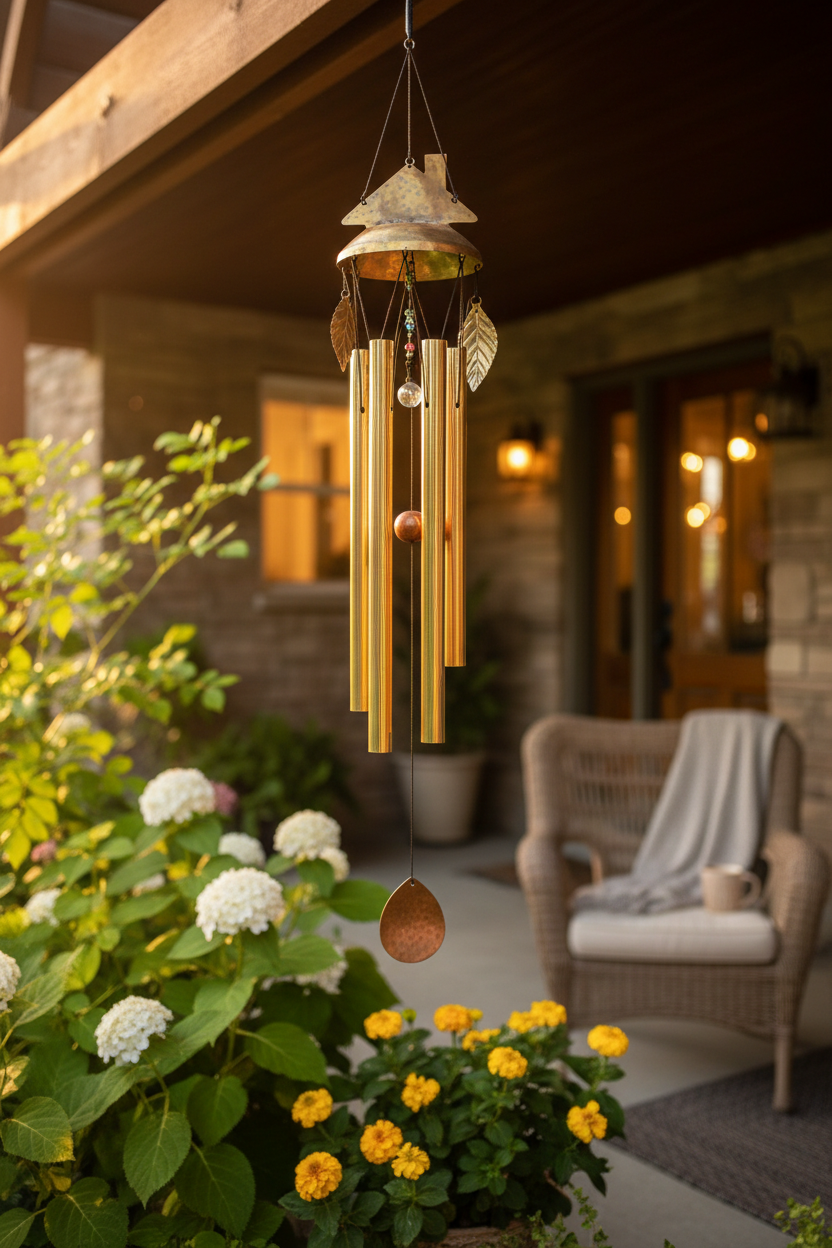
The size of the wind chime changes the pitch character considerably. Compact chimes, such as the Havasu 28-inch model, produce higher-pitched tones that are crisp and present. These work beautifully on balconies and smaller patios where a deeper tone might overwhelm the space. Larger chimes like the Havasu 38-inch pentatonic chimes produce an alto tone deeper, richer, and more resonant. These larger models fill open gardens and porches with a sound that has more body and physical presence.
Wind chimes with properly tuned pentatonic scales show significantly higher listener preference ratings in blind audio tests, with participants consistently describing the sound as "pleasant," "relaxing," and "musical" compared to non-tuned alternatives.
Why Music Teachers Choose Pentatonic Tuning for Outdoor Chimes
There is a reason pentatonic scales dominate early music education. Music teachers know that the five-note scale provides a guaranteed success zone for beginners. When a student is learning to improvise or compose, the pentatonic scale removes the possibility of playing a "wrong" note within the key.
UpBlend Outdoors was founded by a music teacher who brought this same pedagogical insight to wind chime design. The logic is identical: if you cannot control which notes the wind will play, you design a system where every possibility sounds correct. This is intentional sound design applying musical training to an outdoor instrument that plays itself.
Randomly pitched wind chimes are essentially noise-makers. They produce sound, but not music. Hand-tuned outdoor chimes transform the wind into a performance. The difference is not subtle it is the difference between someone randomly hitting piano keys and someone playing within a musical scale.

This expertise informs every aspect of UpBlend's approach, from the initial tube cutting to the final hand-tuning process. If you are choosing wind chimes for your home, understanding the musical background behind the design helps you make a more informed decision.
Music educators have used pentatonic scales as foundational teaching tools for over a century because the scale's structure supports immediate musical success a principle that applies directly to wind chime design.
How to Select a Pentatonic Wind Chime Based on Scale and Pitch
Not all pentatonic scales sound the same. While every pentatonic tuning eliminates dissonance, different scales create different moods. The G Major pentatonic used in the Wailua series has a bright, open character. The E Major pentatonic in the Havasu series leans warmer and slightly more intimate. Neither is better it depends on your preference and space.
Pitch relates directly to tube length. Longer tubes produce lower frequencies, creating that deep, rich tone many people associate with high-quality wind chimes. Shorter tubes produce higher frequencies, creating a brighter, more present sound. This is why the Havasu 28-inch and Havasu 38-inch both tuned to E Major pentatonic sound different despite sharing the same scale. The longer tubes of the 38-inch model create a deeper voice.
When selecting, consider the space where the chime will hang. Small balconies and intimate patios often benefit from compact chimes that do not overwhelm the area acoustically. Large gardens and open porches can support the deeper tones of larger models where the sound has room to develop.
- Space Size: Compact spaces suit 28-29 inch chimes; larger areas support 38-41 inch models.
- Preferred Pitch: Higher, brighter tones from shorter tubes; deeper, richer tones from longer tubes.
- Visual Style: Copper-red Wailua for warmth, classic black Havasu for versatility.
- Gifting Occasion: Consider the recipient's outdoor space and sound preferences.
Once you have selected the right chime, the placement matters almost as much as the instrument itself. You can learn more about mastering wind chime placement to get the best sound from your investment.
UpBlend Pentatonic Wind Chime Models: Tuning and Tone Comparison
UpBlend offers several pentatonic models, each designed for specific spaces and listening preferences. Understanding the differences helps you choose the right chime for your situation.
The Wailua 29-inch Copper-Red Wind Chime features six aluminum tubes hand-tuned to a G Major pentatonic scale. This scale produces a bright, welcoming sound that works well near seating areas and entrances. The copper-red finish adds visual warmth to outdoor spaces, and the teardrop-shaped wind sail catches a range of breeze intensities. This model bridges decorative presence with musical quality equally comfortable as a garden accent or a thoughtful housewarming gift.
The Havasu 28-inch Wind Chime offers a more compact footprint while maintaining the same six-tube, hand-tuned construction. Tuned to an E Major pentatonic scale, it produces a slightly warmer tone than the Wailua, though the shorter tubes keep the pitch in a higher range. This model excels on apartment balconies, small patios, and areas where space is limited but sound quality cannot be compromised.
For those seeking a deeper, more resonant tone, the Havasu 38-inch Wind Chime uses the same E Major pentatonic tuning but with longer tubes. This added length drops the pitch into an alto range, creating a sound with more body and sustain. The ash wood components and black cords give it a presence suited to larger porches and garden settings. An adjustable clapper allows you to modify how readily the wind activates the tubes.
| Model | Scale | Tube Count | Size | Tone Character | Ideal Space |
|---|---|---|---|---|---|
| Wailua 29-inch | G Major Pentatonic | Six tubes | 29 inches | Bright, welcoming | Patios, entrances, gardens |
| Havasu 28-inch | E Major Pentatonic | Six tubes | 28 inches | Warm, compact | Balconies, small patios |
| Havasu 38-inch | E Major Pentatonic | Six tubes | 38 inches | Deep, rich alto | Porches, large gardens |
All three models use 6063 aluminum tubes built for outdoor use. The attention to tuning means each chime produces genuine musical results rather than simply decorative sound. For additional options, you can explore the Kindness Collection for more hand-tuned designs.
Key Takeaways: Why Pentatonic Scales Create Superior Wind Chime Sound
The pentatonic scale is not a marketing gimmick it is a musical principle with real acoustic consequences. By eliminating the intervals that create dissonance, pentatonic tuning ensures your wind chime produces music rather than noise. This matters because you cannot control the wind, but you can control what notes the wind plays.
UpBlend's approach to pentatonic tuning reflects intentionality at every level. From the music teacher founder to the hand-tuned construction, each chime is designed around sound. The result is an outdoor instrument that honors the unpredictability of nature while maintaining musical integrity.
For gift-givers, this tuned approach provides confidence. A pentatonic wind chime arrives as a meaningful gift precisely because the sound has been considered. It is not a decorative object that happens to make noise it is a designed instrument that happens to be beautiful.
- Guaranteed Harmony: Five-note tuning eliminates dissonant intervals by design.
- Wind-Proof Music: Random wind patterns still produce musical, melodic results.
- Intentional Design: Hand-tuned tubes reflect musical expertise and careful construction.
- Emotional Resonance: Musical sound creates meaningful moments for recipients and homeowners.
- Lasting Quality: Built for outdoor use with materials chosen for acoustic and visual longevity.
Once you have your chime, knowing where to hang wind chimes for maximum sound ensures you get the full benefit of pentatonic tuning.
Frequently Asked Questions About Pentatonic Wind Chimes
Are pentatonic wind chimes better than chromatic wind chimes?
Yes, for outdoor use. Pentatonic tuning eliminates the half-step intervals that create dissonance when notes sound simultaneously, while chromatic scales include all twelve semitones impossible to render musically in random wind. Chromatic tuning works for controlled instruments, but pentatonic design handles nature's unpredictability.
Why do pentatonic scales use only five notes?
The five notes are selected intervals. By removing the fourth and seventh scale degrees from a major scale, the pentatonic set retains only the consonant intervals. This mathematically guarantees that any combination of notes sounds harmonious impossible with a full seven-note or twelve-note scale.
Which pentatonic scale is best for beginners choosing a wind chime?
Either G Major or E Major works well. The G Major pentatonic in the Wailua series offers a brighter tone, while the E Major in Havasu models leans warmer. Both eliminate dissonance equally well, so choose based on your pitch preference and the size of your outdoor space.
Does tube material affect the pentatonic sound?
Yes, material changes tone character significantly. Aluminum tubes produce bright, clear tones with excellent sustain, while steel sounds harder and bamboo offers a softer, more percussive quality. UpBlend uses 6063 aluminum specifically for its balance of resonance and durability in outdoor conditions.
Can you retune a pentatonic wind chime to a different scale?
No, not practically. Tubes are cut to precise lengths during manufacturing to produce specific pitches. Retuning would require recutting and rebalancing each tube, which is not feasible. If you want a different scale, choose a wind chime originally tuned to that key.
For maintenance and enhancement options, you can explore wind chime accessories that help protect and customize your outdoor instrument.


